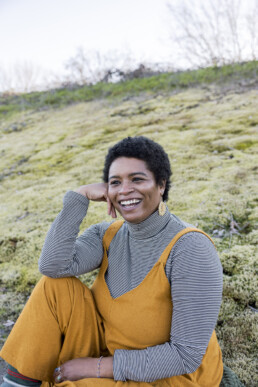
ZOË GAMELL BROWN
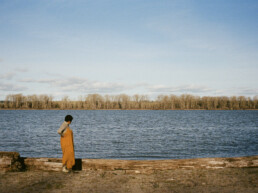
“I’ve been a storyteller my entire life and that has just changed with the different skills or resonances I’m meeting.”
Name: Zoë Gamell Brown
Pronouns: She/They
Background: East Coast-born, Gulf Coast-raised storyteller and river steward who carries Boviander knowledge from Guyana to Wapato Island
Medium of choice: Storytelling through film, creative nonfiction, poetry, pottery, paintings, & sometimes textiles
Astrological Sign: Sag Sun, Sag Rising, Libra Moon. In Sidereal astrology: Sag Sun, Sag Rising, Virgo Moon
Karaoke jam: “Electric Relaxation” by A Tribe Called Quest or “Evil” by Interpol (depending on the audience)
Local artists you’re excited about: What has made me fall so deeply in love with Portland are the artists here. If I had to put names into a place, even though it’s so hard, I think immediately off the cuff [I would say] Adriene Cruz, Intisar Abioto, Sharita Towne, Bridgette Hicky, Epiphany Couch, and Olivia Camfield.
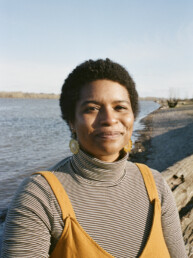
As early as pre-kindergarten, Zoë Gamell Brown was obsessed with reading. Once, Brown finished an entire book in a day and her visiting grandmother–astounded by the child’s appetite for stories–discovered the ever-growing library in her closet.
Her storytelling journey began there and hasn’t stopped since. At the age of seven, she moved from New Jersey to Atascocita, Texas, right outside of Houston. A city built on a swamp–where else to explore the eclectic and bizarre? It’s where she built her love for the earth and began her creative practice, dreaming and visioning beyond language, space, and time.
A Ph.D. candidate at University of Oregon’s Indigenous, Race, and Ethnic Studies program, Brown’s scholarship began as a way of understanding her mixed identity within the social and political contexts in which we find ourselves. Her film projections are a reflection of this journey, where the language of theory greets the tumbling and rolling river. The earth is always the protagonist, even when she’s not visibly present–an undercurrent that serves as a reminder of our humanity and the ways that we can reshape history through our own futuristic visions and desires.
“I’m so grateful for my matriarchs who have done a world of work to retain our names, places, and recipes we use to take care of ourselves in where we have called home.”
What has your journey been to claiming your identity as an artist?
At the root of all I do, it’s easier for me to say I’m a storyteller than to say I’m an artist or a writer or a filmmaker. I’ve been a storyteller my entire life and that has just changed with the different skills or resonances I’m meeting. The older I get, the more I realize the responsibility I have of being a Guyanese storyteller.
Since I was a child, my family has been like, “You’re the storyteller of the family.” Now when I go home, they expect that I have my camera and journal. There’s so much care and attention around me being a storyteller and there always has been, regardless of what we were going through and the challenges of being human. [Identifying as a] storyteller allows me to feel more in my understanding of how I exist as a person in this world.
"Being able to meet the river, introduce myself, and understand all the rivers in the world are connected moved me. Knowing I can tend to my ancestral rituals and relationships here was life-changing."
When did Portland become home for you and how does this land and/or community inform your work as a Caribbean Black Indigenous artist?
The first year in Portland, I had so much grief in my body I wasn’t really able to understand what it would be like to be a part of this community. What has helped me understand that I can be in my most vivid and wildest dreams are the people and the land. I was fortunate—within the first year or so to be invited to an artist residency at the Sitka Center for Art and Ecology through Intisar Abioto’s Black Artists of Oregon exhibition. Being in the forest with so many inspiring artists who are actively making imprints on the region that we call home was profound.
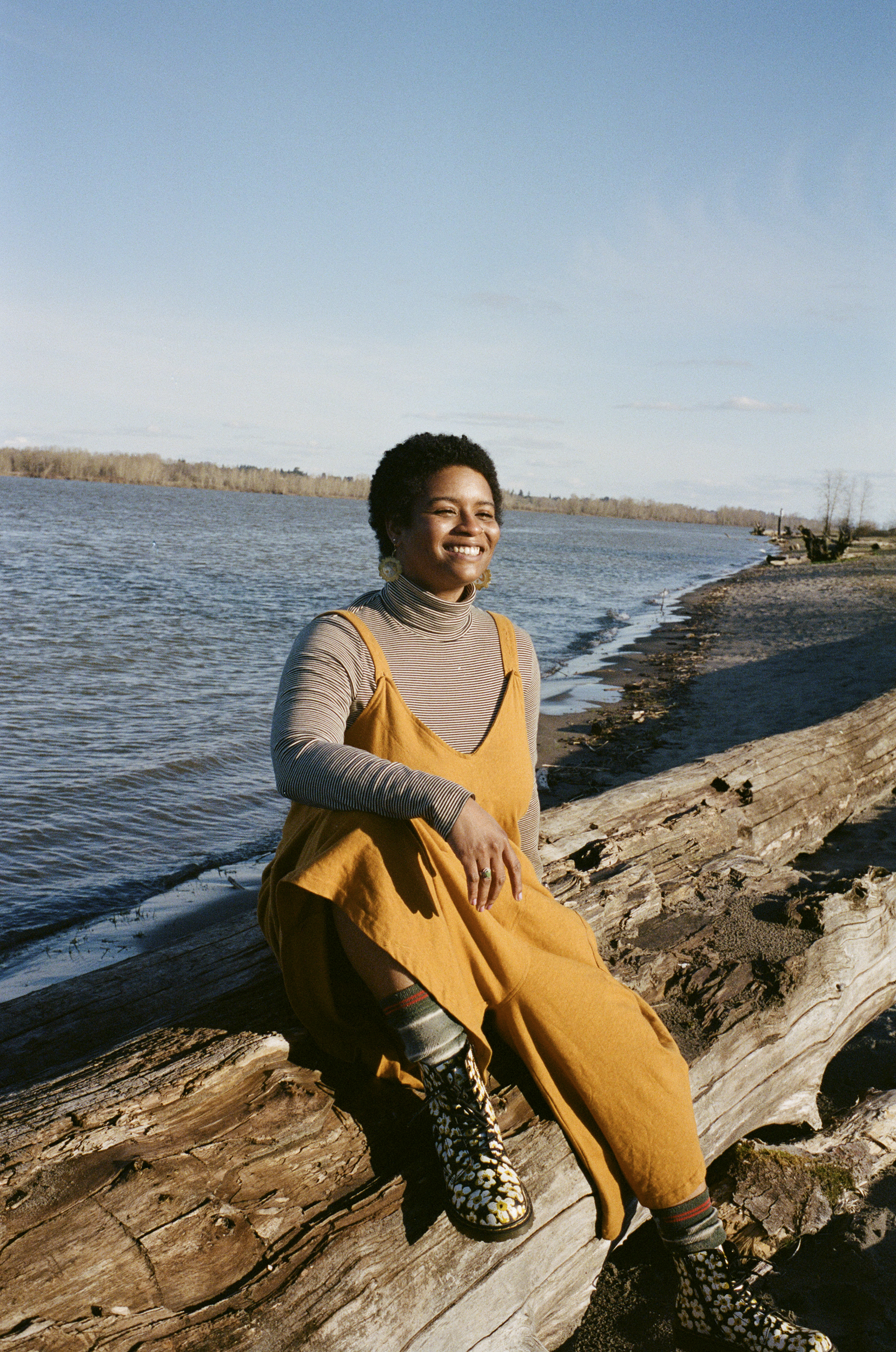
Then coming back into town and getting to know Wapato Island where we are today and understanding how much the Island has historically been a place of exchange, reciprocity, and regeneration for Oregon tribes. Being able to meet the river, introduce myself, and understand all the rivers in the world are connected moved me. Knowing I can tend to my ancestral rituals and relationships here was life-changing. I give so much of my gratitude to this Island and Wapato Island Farm. My dear auntie and the farm’s matriarch Jennifer Rose Marie Serna was another person who accepted me just as I was in all my grief, joy, and celebration. The way I’m able to come into my body, which of course extends to so many other beings, has been possible here. There’s so few words in the English language that can really speak to that sometimes.
As a Ph.D. candidate in Indigenous, Race, and Ethnic Studies, can you tell us about your dissertation?
I was doing a lot of work with my family–I’m so grateful for my matriarchs who have done a world of work to retain our names, places, and recipes we use to take care of ourselves in where we have called home.
Guyana is quickly becoming one of the largest exporters of oil in the world. When you see Guyana on a map in comparison to the larger countries around it–and we could talk about borders all day but for the basis of where we are now–it’s so interesting to think of a place that is small in comparison to Brazil, Colombia, or Venezuela. Yet, [Guyana] has the highest rates of suicide, alcoholism, and femicide in the world. How is that all happening at the same time?
Guyana’s also providing one of the largest amounts of sand, which is a completely underestimated resource. Sand goes into cell phones, buildings, sidewalks, and cars. And after water, we are running out of sand in the world. So all of these things are happening in this really small place that is also having to deal with the ongoing colonial and imperial force of the United States, the ongoing negotiation of which border deserved to be where for oil resources.
I could think about this as a theorist all day, but the reality is that I go home and I see the pools of oil spilled all over the ground. I see the rupture of lives as homelessness increases in Georgetown, in a country where you could live in the forest easily. How does that happen? It’s contentious being American and Guyanese and seeing what America continues to do to Guyana, but also feels like my responsibility as someone who’s American and Guyanese to use the access of academia to link all of these things together. I’m so fortunate to thinkers like Oneka LaBennett, Walter Rodney, and Andaiye, who have done the work and I just get to be a steward of carrying the messages forward.
“If I truly believed that intergenerational trauma and healing are real, and if I really believe in regeneration and reincarnation, then I have to also believe that I chose to be here right now.”
How has your scholarship informed your art practice?
The deliberate ways I was trying to understand Boviander Guyanese histories and futures, and my place in all of it–there’s so much curiosity, open-ended questions, and not-knowing. Film allowed for me to work in-between the citations and the bibliography, to be like, here’s what I can do, here’s what is possible, here’s what the missionary logs say. And then here are my films that allow for those curiosities to be possible and allow for those questions to not be answered, because I also respect that there’s so much I’ll never know.
[As a concept], I use weave a lot in the work because I love Édouard Glissant, one of my most profound teachers and philosophers of Caribbean life. I really believe in the power of us as multitudes of people, lineages, and lives. It’s exciting to see the scholarship speak to the filmmaking and then have the filmmaking speak to the scholarship and realize that–in my dissertation specifically– there’s no way it could be told without the other. It wouldn’t be the project that it needs to be if the artistry wasn’t possible. And the artistry wouldn’t be possible if I hadn’t done the work in the conversations with elders and the citations to get to this part of understanding the story.
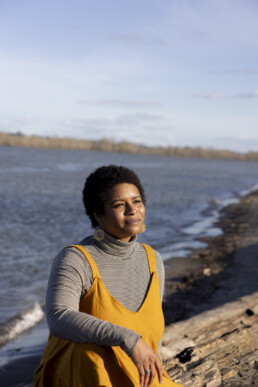
"It’s contentious being American and Guyanese and seeing what America continues to do to Guyana, but also feels like my responsibility as someone who’s American and Guyanese to use the access of academia to link all of these things together."
Your work speaks so much to grief–how imperialism and colonization has and is destroying the earth and all the living beings on it. How are you holding this grief and accompanying rage? And how do you find balance?
I love a good cry. I think it’s so important–especially for Black and Brown women and people who are not often awarded the opportunity to be in their grief–for us to cry. For us to be in the insanity of what this time is. I’m thinking about Palestine, Sudan, Congo, Iran, Haiti, Puerto Rico, Ethiopia, Venezuela, Guyana, the United States, and and and and…It’s an explosion of grief thinking about and communing with the [Global] South. So I cry about it a lot. And I talk to my friends. And I ask the river for guidance and I’m so grateful for the matriarchs who have been through some shit.
If I truly believed that intergenerational trauma and healing are real, and if I really believe in regeneration and reincarnation, then I have to also believe that I chose to be here right now. That I chose to be in relationship with all the many beings that make life possible. If my matriarchs were enslaved, had their land stolen, had the potential for their hands to be chopped off every single day, and I’m still here? Yeah, I think I can show up.
I can go to the farm and understand how to plant garlic in the most simple and beautiful way. What else do you do but show up? It’s not easy in any sense of the stretch and that in and of itself is a miracle. One of my most beautiful sister friends [is] Wakumi Douglas. Sometimes, when she’s opening us to a meal, she’ll say, “They really tried to kill us and we’re still here. Isn’t that a miracle?” And we laugh and laugh and laugh. What else do you do but be in the miracle?