BINT BANDORA
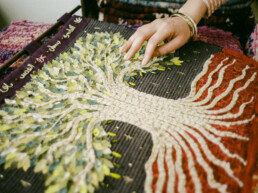
“Free Palestine. We will return to the land and Palestinians deserve the right of return and deserve liberation, dignity, and equality. And Palestine will be free.”
Name: Bint Bandora
Pronouns: She/They
Background: mixed media creative & queer human whose artistic world view is through the lens of being Palestinian in diaspora
Medium of choice: Illustrations, textile art (sewing, tatreez), collage, & henna
Astrological Sign: Pisces Sun, Taurus Moon, Capricorn Rising
Karaoke jam: “Linger” by The Cranberries & any ABBA song
Local artists you’re excited about: Sa’rah Melinda Sabino, a Moroccan painter & henna artist; Yoko Okay a Japanese comic artist; Sarah Farahat, an Egyptian muralist, printmaker, & illustrator; and Amirra Malak, an Egyptian Khayamiya artist.
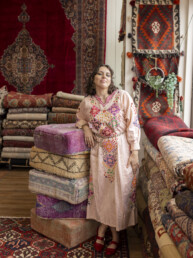
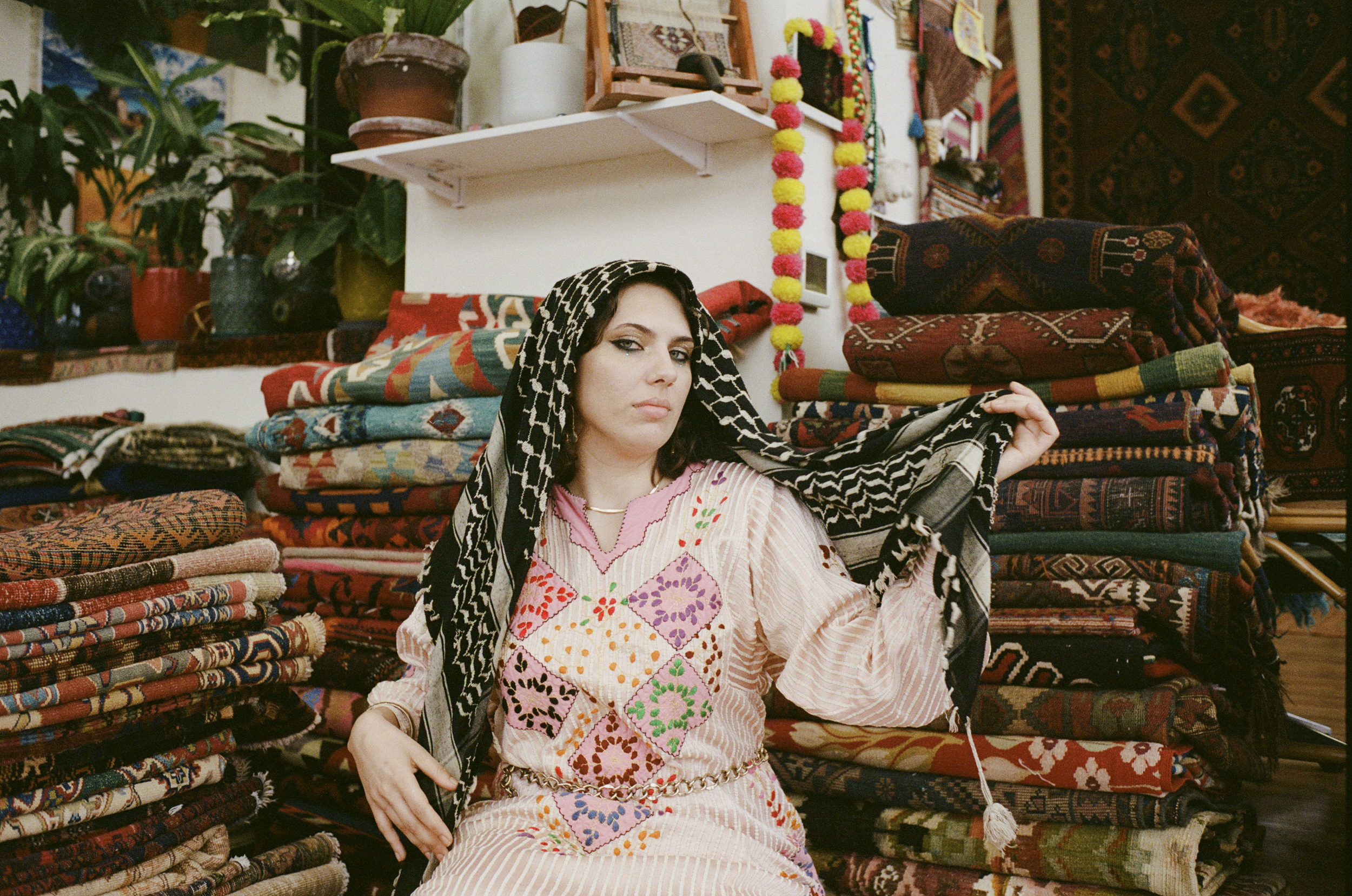
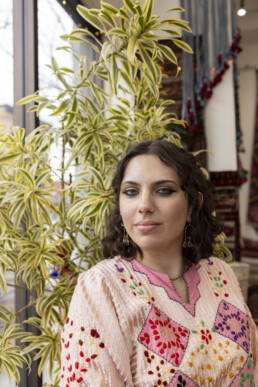
Bint Bandora means tomato girl/daughter in Arabic. Inherited first as a nickname from her family, Bint Bandora has transformed this into her art alias and practice. Born and raised in the Bay Area to a Palestinian father, Bint Bandora moved to Portland in 2014 to attend art school. Eventually she dropped out due to various circumstances, but her artistry has evolved since through her explorations of identity, queerness, and ancestral grief.
Women in keffiyehs and thobes, olive branches, and the Palestinian flag–Bint Bandora’s work carries very clear messages. In the confusing currents we find ourselves in presently, it is refreshing to experience this clarity–a north star towards the collective liberation we all deserve. In many ways, her craft represents what artistry can look like through community and how cultural preservation lives within resistance and ancestral love. As she said so poignantly during our interview at Nomadic Vintage, flanked by woven rugs carrying their own histories: “Free Palestine. We will return to the land and Palestinians deserve the right of return and deserve liberation, dignity, and equality. And Palestine will be free.”
“The support of my community is the thing that informs my artistic practice the most.”
What has your journey been to claiming your identity as an artist?
Something I realized recently was that pretty much everything I know about myself and my identity I learned through my art practice. When I first started making art, I was making things that I liked but weren’t necessarily from my identity or culture. But then in 2020, 2021, tensions started rising in Gaza and I basically realized that I’m Palestinian and I have this tool, [which is] my artist practice. I felt the call to use that to speak up for the cause of Palestine, to speak up for the liberation of my people, and to do whatever I can through my artistic medium because in diaspora it can feel like you’re separated, you’re far away from the cause, from the people, from the homeland. My art is my way of connecting, learning ancestral practices, and meeting other Palestinians and community here and in other places.
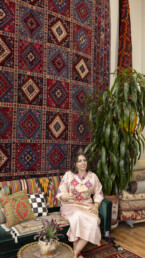
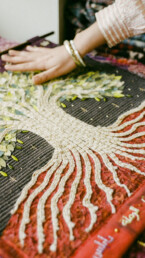
"I felt it was absolutely time to express that grief through my art because you can only hold something in for so long."
When did Portland become home for you and how does living here inform your work?
Portland became home to me almost twelve years ago. Being here informs my artistic practice mostly because of the community I’ve found, which wasn’t easy–it took many years. But over the past five-ish years, I’ve really locked in with an incredible SWANA community. SWANA is South West Asian North African. There are definitely a lot of Palestinians [in my community], but also a lot of people from other cultures within that region because we all share a lot of similarities. The central theme in my community is that we’re all anti-Zionism, which is super key.
The support of my community is the thing that informs my artistic practice the most. The art community that I’ve found is very supportive, uplifting, and not competitive. And every opportunity I’ve had has been sent to me from a friend. I’ve found Portland to be very ripe with opportunities for small artists. Having dropped out of art school, I’m self-taught and very DIY and all my education has been through local art institutions like the IPRC, Outlet, and Sincere Studios. Over time, I’ve realized that I’ve been educated by the other artists in Portland and their offerings to the community.
Your work revolves around themes of Palestine, mothers, and grief, all of which are deeply personal topics. In thinking about art as a mode of healing and self-care, how do you know when you’re emotionally ready to release a piece out into the world?
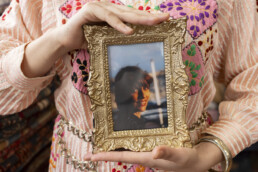
Grief, motherhood–these are things that are constantly on my heart and mind. My mother passed away four years ago. She was my best friend so it was really life-shifting for me and has completely influenced my artistic practice. An example of when I’m ready to share these really vulnerable things–it’s when I can’t get something out of my head. For example, my thesis project for the portfolio program at the IPRC last year was a twenty-page comic I made about my mom and the six months from when she was diagnosed with cancer to when she passed away. That was the most vulnerable piece of art I’ve ever made. I was crying through it and had to take a lot of breaks. But it was three years after she had died and I felt it was absolutely time to express that grief through my art because you can only hold something in for so long. It was an incredible lesson for me because I’ve found such relief after putting that out. There are some moments in there that I never thought I would share publicly, but people have resonated with it in a way that I never would’ve imagined. It has made me realize the more you can share your vulnerability, your grief, your truth, the more the art will resonate.
Since expressing those [feelings] in my comic, they haunt me less. I’ve learned that I can’t really go wrong when I do [share]. I ultimately will always want to try to lean into that more. There’s so much to gain from sharing those vulnerabilities–I’ve gained a lot from it and I feel like my mom would be proud of that bravery.
“We’ve created our own line of grandmas, moms, and aunts teaching each other–it’s like we’re all each other’s aunts or grandmas or mothers at different times.”
I saw that you have been doing textile work with tatreez (Palestinian embroidery). Cultural preservation–particuarly in the face of genocide–is so important. How do you continue learning and practicing traditions as a person of the diaspora?
So it’s interesting because tatreez is typically a practice that’s passed down from grandmother to mother to daughter in Palestine. I didn’t get that–not only because I’m in diaspora but also my Palestinian lineage is from my father’s side. So, I came to a point where I knew I wanted to tap into my cultural practices more. When it came to learning tatreez, I was really lucky to find my teacher Wafa Ghnaim who is also in the diaspora and teaches online. I was able to take one of her classes and the community that she has created has basically revived the practice of tatreez in the diaspora. I’ve been really lucky to learn through her. On top of that, her mother Feryal Abbasi-Ghnaim lives in Portland and she is the grandmother of tatreez. She’s the one who taught Wafa. Actually in one week, I actually get to go with Feryal to the Oregon Folklife Network Culture Keepers Gathering, which is a gathering of folk artists in Oregon.
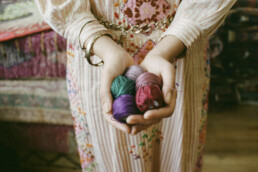
I’ve been really, really lucky to find these women–these culture keepers–near me that are keeping these practices alive. We’ve created our own line of grandmas, moms, and aunts teaching each other–it’s like we’re all each other’s aunts or grandmas or mothers at different times. Sometimes I have resented being in diaspora and have had a lot of mixed feelings–like I am not educated enough, close enough to my culture, know the language well enough. So, it’s been really amazing to have a practice like tatreez. There’s nothing between me and the practice–it’s not like my father connecting me to the homeland or a language barrier. It’s me directly with the practice. It’s something that is deeply, deeply rooted in Palestinian culture and especially the life of women in Palestine. While doing tatreez, I picture me and all the women that were before [me], are around [now], and still to come, and here we are stitching the same motifs that we have been stitching forever. That’s a really cool feeling that has helped me to keep this cultural practice alive.
"The only way to get to the other side of an emotion is to feel that emotion and to go through it."
Your work as activism and resistance reminds me of the phrase “the personal is always political.” How do you balance the rage, injustice, and accompanying grief happening on a personal and global level?
This is a question that my community and I are always thinking about and feeling. There’s definitely not one answer as to how to live in a time of multiple genocides plus all the other stuff that’s happening. How do you balance that with even wanting to make art, wanting to be around people, wanting to try to live a good life where you’re still learning and growing all the time? For me, it’s a constant trial and error. The number one thing is my community because being around other people who also know what’s happening in the world, talk about it, and are affected by it frees me up to have those moments of carefree times in between. Surrounding myself with people who are also doing things to work towards a better world has allowed me to not be in anger and grief 100% of the time.
Another thing is something I learned when I lost my mom. The only way to get to the other side of an emotion is to feel that emotion and to go through it. So, I have found that I need to let myself feel the anger, feel the grief, cry, feel all those feelings in order to be able to take a breath on the other side and have those moments where I feel loved and cared for until I feel angry again, and then it circles back to feeling joy again. It’s a cycle, it’s life. Feeling those emotions–maybe it’s because I’m a Pisces–is something I’m pretty good at. Alhamdulillah thank god, because the only way out is through. Using my art as a means of activism has helped me feel like I’m channeling this and that I’m doing something.