MARYANNA HOLLOMON
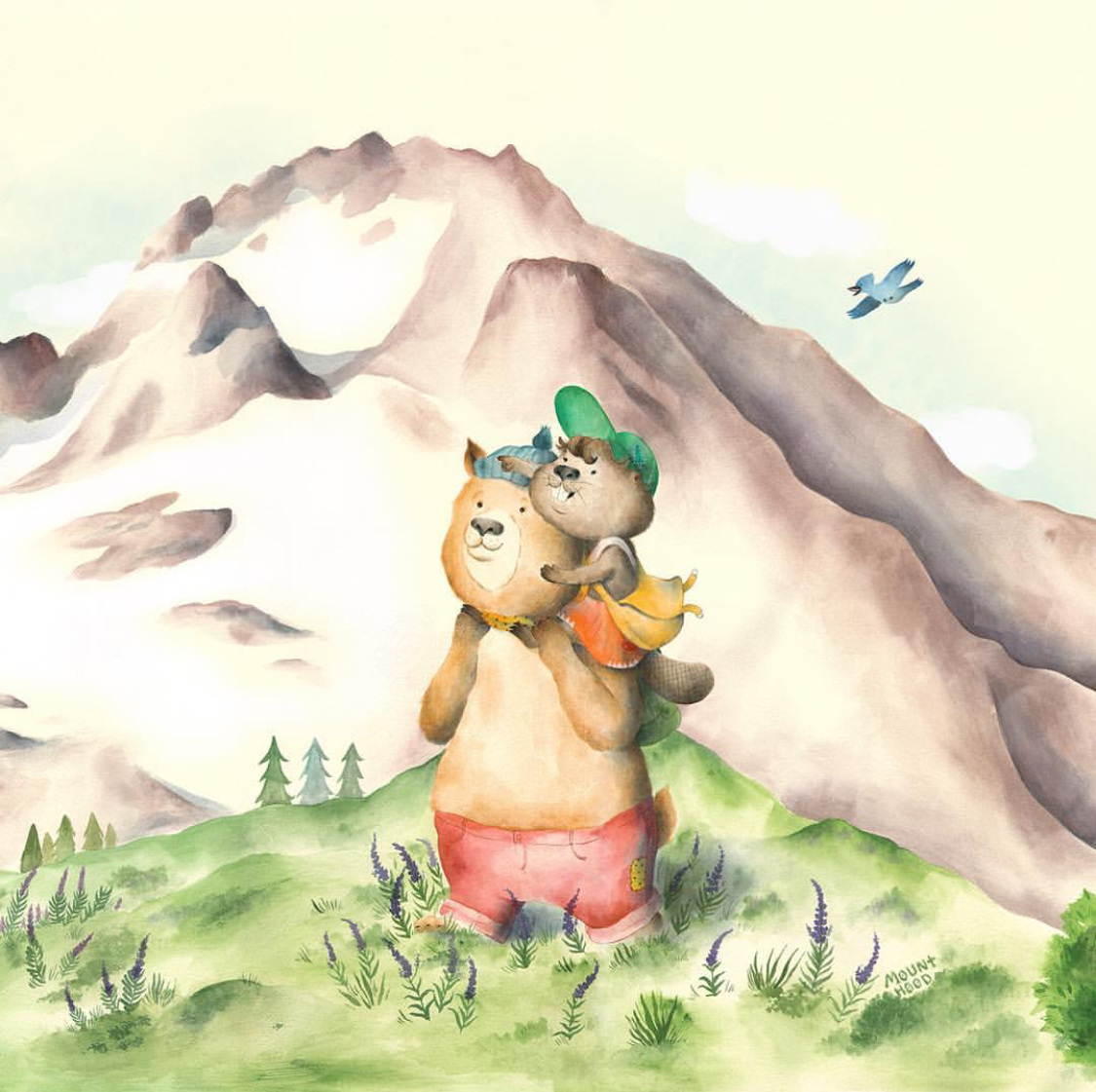
“This is a dichotomy that will always run through my work – celebrating the joys and wonders of childhood, while strongly advocating for the right of all children to enjoy peace, security, and to live free of war and violence.”
Name: Maryanna Hollomon
Pronouns: She/Her
Background: Fil-Am
Medium of choice: Illustration
Astrological Sign: Cancer
Karaoke jam: My jam of choice is “Sitting on the Sidelines Watching Other People Sing”
Can you tell us a little about your background?
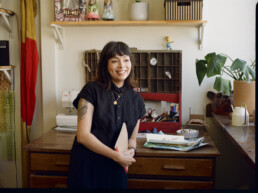
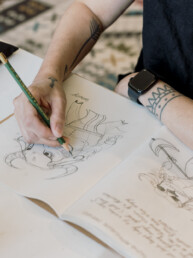
I’m an artist and illustrator. I was born in the Philippines where my dad was stationed by the US Navy, and we left while I was still a baby. We moved a lot when I was a kid and I lived in a few different countries, but I mostly grew up in Arizona where my dad is originally from. I came out to Portland for art school and then dropped out a little while later, and afterwards I was bartending for a long time in a little neighborhood bar, slowly picking up freelance jobs on the side. Then I decided to follow my dream and finally become an illustrator full time. I quit my bartending job, which was really scary. It was like taking a bet on myself.
It took a couple years, but after a while, I was constantly working and experiencing some success, landing a lot of dream jobs. I did some public art, commercial freelance work, and gallery shows. I did murals, and I had my first children’s book. Then my husband and I decided to have children and that changed everything. And now, two kids later, I’m approaching the other side of that. My kids will both be enrolled in school this Fall, and I’ll be returning to my studio full time.
Tell us about one of your favorite Portland memories.
This is hard, there are so many! Sledding in a bus tub after my bartending shift during the Snowpocalypse, going for runs around the waterfront with friends, any kind of gathering with our Filipino community, and now spending time with my family and experiencing Portland through the eyes of my children.
“I’m so strongly tied to the identity of being an artist that when I wasn’t creating, sometimes I would question if I even am still an artist”
Please share a time it was difficult living in Portland.
Portland has been the backdrop to many challenging times in my life but living here has never been difficult, even when I was flat broke. Honestly the most difficult time was my recent absence from Portland – I love this city so much and I’m so glad to be back.
You spent several years as a volunteer organizer for Gabriela. How did you initially get connected with them?
My parents divorced when I was very young, and I grew up without my Filipino mother and almost entirely removed from Filipino culture. I was looking for Filipino community and doing Google searches, and I stumbled upon Gabriela’s Facebook page. It is a community organization made up of Filipinas. I nervously reached out and, I mean, when I first entered the space, I felt like an alien. It was so strange to be confronted by people who shared my identity, other Filipinos who are mixed like I am. I never had that in my life, and to find it in Portland was such a wonderful thing to discover. I remember having those first Gabriela meetings with this room of Filipino women, and just crying my eyes out because it was so emotional and beautiful at the same time. I felt like I became more of a whole person.
How do you stay inspired in Portland?
Inspiration is easy to come by, it’s finding the time that’s hard.
A lot of your work interweaves activism alongside the curiosity and wonder of childhood. Can you talk about how your work with Gabriela has informed your practice?
Before becoming a part of Gabriela, I didn’t address my identity at all. It was always something that I felt disconnected from and kind of just shoved into a corner. And I also didn’t know any other Filipino women for the entire time that I was living here, until I became a part of Gabriela. I learned so much about Filipino and U.S. history – about colonization, exploitation, and imperialism – that it opened up an entire worldview that I couldn’t ignore in my work. Through Gabriela, I also became passionate about human rights, especially in regards to the Philippines, that I went in pretty hard on creating political work. It took me a little while to figure out how to balance it all without compromising on my mental health.
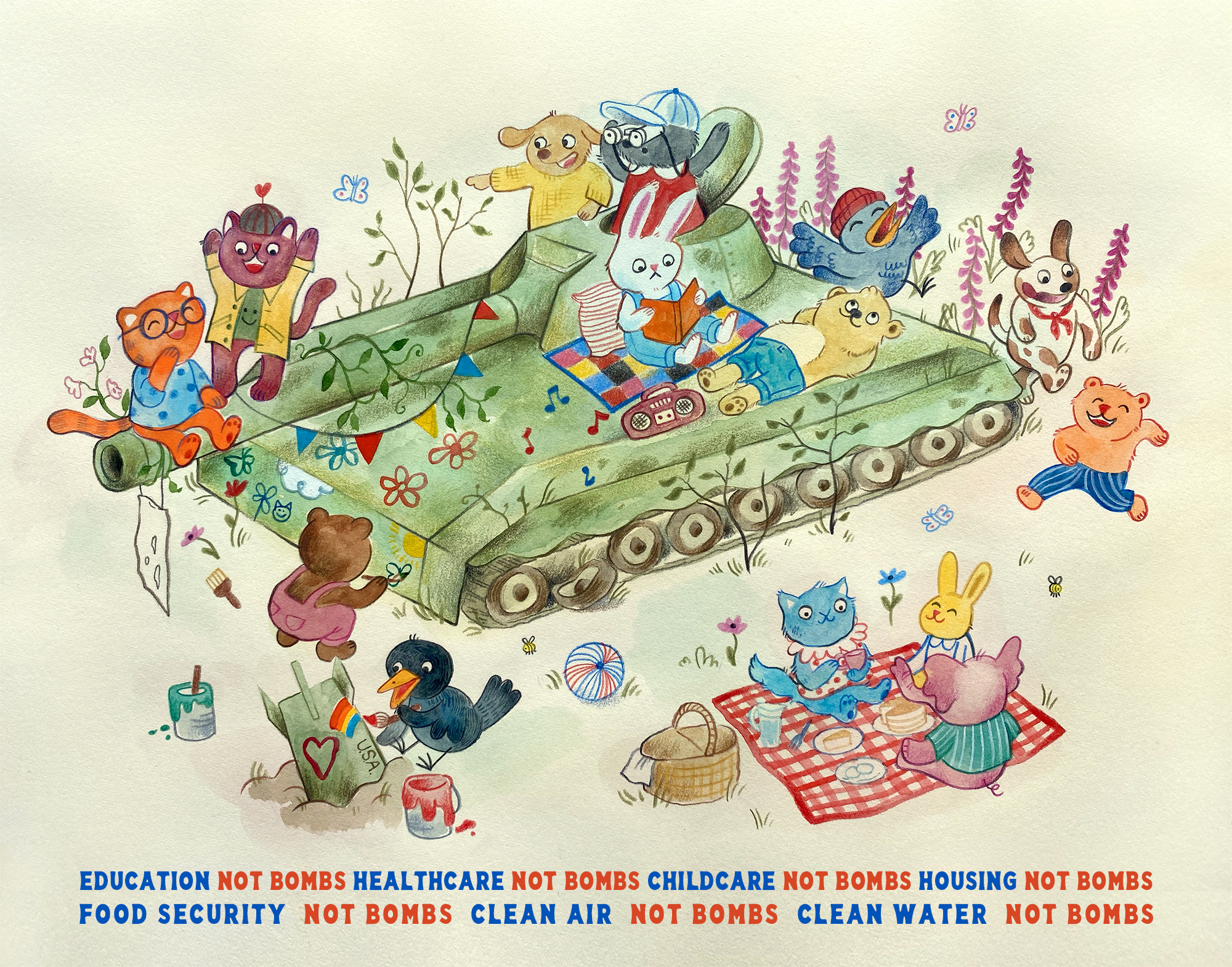
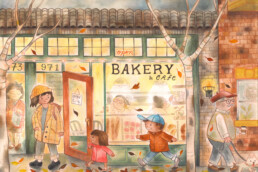
I’ve always had an interest in children’s illustration and books for children, so that my work naturally gravitated towards that audience. After having children of my own, I get to enjoy the magic and wonder of experiencing the world through their young eyes. I am also deeply and painfully aware of the privileges we are afforded, and how the nation I call home and the taxes I pay fund violence and terror all over the world. This is a dichotomy that will always run through my work – celebrating the joys and wonders of childhood, while strongly advocating for the right of all children to enjoy peace, security, and to live free of war and violence.
I’m curious if you could speak a little bit more to your identity as a parent. My kid isn’t much younger, so it’s newer for me, but I think that a lot of my first time parent friends are also experiencing this change in identity. For me, I’m constantly trying to not think of it as a loss, I don’t want the pitying for how my time has changed. I know my life is richer in different ways, but there is still an internal dialogue with for myself about who I am as a person, and also wanting to be a person outside of my identity as a parent. How have you reflected on your own identity as a parent and an artist?
First of all, it does feel like a loss. It does feel like you’re mourning a version of yourself that no longer exists. My second child was born at the start of the pandemic, and we were living on the other side of the country. If it weren’t for other moms on social media, I probably would have felt guilty about all these feelings. But recognizing that so many moms are experiencing the same notions of loss and crisis in identity was extremely validating. I was like, ‘Okay, I’m not alone.’ Especially as an older mom (I didn’t have Jun until I was 37) who was more established in an independent life, it was a dramatic shift to parenthood.
The expanse of free time and the opportunity to feel boredom is so vast, and all of that is just gone so quickly. You spend all this time being pregnant and preparing for the baby, but you’re not prepared for how much your life changes after the baby comes, and how your body changes. I had postpartum depression with both children and really struggled with breastfeeding. Oh my god, I’ve done some hard, physical shit in my life. I’d rather do unmedicated labor again than go through breastfeeding.
I’m so strongly tied to the identity of being an artist that when I wasn’t creating, sometimes I would question if I even am still an artist. I think the hardest transition was when they stopped napping. I have also come to realize how much alone time I need to think – so much of art is just thinking! How the heck am I supposed to draw if I’m constantly overstimulated? I don’t have the answer, and I always wonder how other artist parents do it while raising young children.
Now, this is all making it sound horrible and terrible. I want to be clear, there’s a lot of joy in parenting too, but we’re talking about the struggles, because I think we don’t get to acknowledge them enough. As time goes on and they get older, it gets easier, and I can reflect on it with more clarity. I’m getting more comfortable with myself as an artist AND a mother.
“Am I washed now? Can I still do this? These are thoughts I have struggled with since my kids were born, and conversations like this have been a lifeline.“
When we think of the arts, we don’t have a lot of conversations about parenting. At least for me [as a photographer], it’s still stigmatized– if your art becomes about your children, it’s less valuable in some capacity. And yet you’re a different form of yourself, on top of not having the time to practice uninterrupted. If we want the arts to flourish, we also need to support families, or artists who have families, no matter what those families look like. This shouldn’t have to be a choice.
There are so many contradictions to raising children. Childcare is insanely expensive and my income as an artist wouldn’t even cover it, but also, I would be missing those critical years of childhood if I continue working. But if I don’t continue working, will the gap in my career cost me work in the future? Am I washed now? Can I still do this? These are thoughts I have struggled with since my kids were born, and conversations like this have been a lifeline.
We are living in a country that wants to force us to give birth but offers very little in terms of critical support for children and young families. We need postpartum care and parental leave, free and robust education, not more militarized police. We need youth-centered community programs and free lunch for school children, not more bombs in endless wars. And on a local level, we need to continue to invest in the arts, including grants for new, young, or struggling artists, and funding arts and music programs in our schools.
I do agree that in the arts, raising children is something that isn’t talked much about. Historically speaking, the art world has centered men, and nobody was asking them, “as a parent, how do you do it?”. Hopefully now that we are pushing for a more equitable lens, that conversation can change.
What does work look like for you these days?
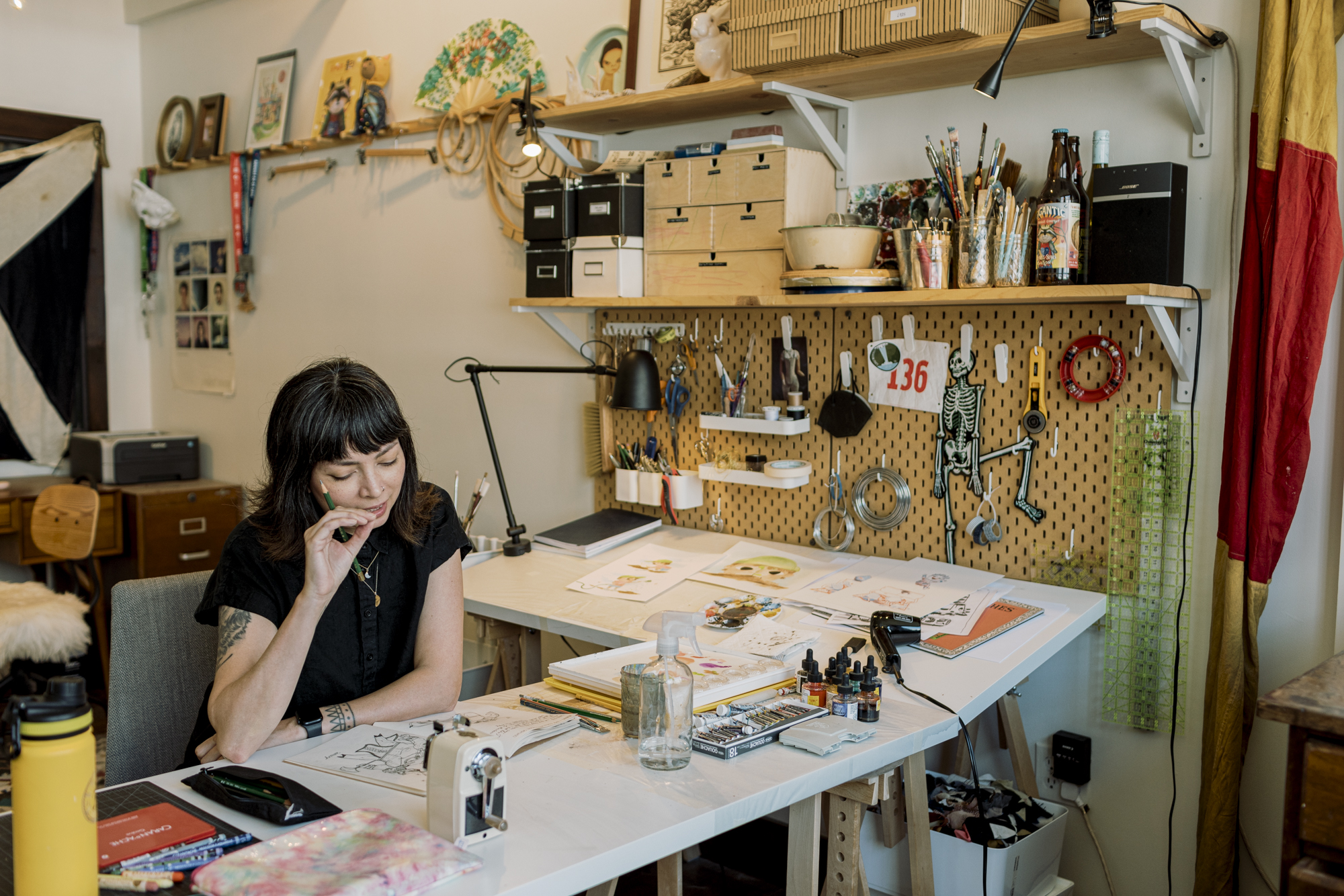
I’ve worked sporadically since becoming a parent, but that was only when we could afford part-time childcare (or when they napped in their younger years). This Fall, both my children will be enrolled in school, so for now, I’ve put my art practice on a shelf so that I could enjoy these last several months of my youngest being home. To be real, I simply cannot form a creative thought while my child is asking me a question every 10 seconds.
"I learned so much about Filipino and U.S. history - about colonization, exploitation, and imperialism - that it opened up an entire worldview that I couldn't ignore in my work."
What are some of the ways being a parent has informed your work now? How has your work changed?
Yeah, they’re hilarious. I have a running list on my phone’s Notes app of funny things they say. What’s really fascinating is that, with very little encouragement on our part, my son Jun is a natural born artist. He spends way more time drawing than I do every single day.
They also get me outside when otherwise I would be in my dungeon of a studio working way too much. I had no work-life balance before. I love my job, but it definitely wasn’t healthy. Also, just being around their playful energy allows me to see the magic in the mundane. I have a lot more gratitude for the small things these days. I won’t know until I start putting brush to paper on the regular again, but I already sense that I want to approach my work in a more loose, playful way.