INÉS PAULINA RAMÍREZ
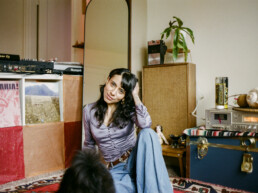
“We can reimagine it, spaces where we can breathe, systems free of capitalism and patriarchy as well. Just like creating an autonomous system of imagination that is not conditioned to a capitalist system.”
Name: Inés Paulina Ramírez
Pronouns: She/Her
Background: Studied Fine Arts in Ecuador and Masters in Public Art in Mexico
Medium of choice: Mixed Media Multidisciplinary Artist, Music, Print, Painting and Collage
Astrological Sign: Sagittarius Sun, Capricorn Moon, Aries Rising
Karaoke jam: Losing my Religion, Eternal Flame, and anything by Selena and Shakira
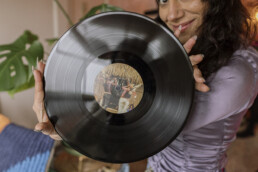
Local artists you’re excited about: Espina Letal knows about Chicano music and Mexican music. Enjoys how she curates and collects vinyl. Sharita Towne has created beautiful prints and worked with community
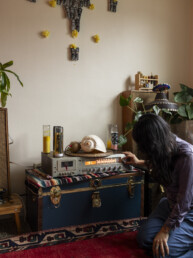
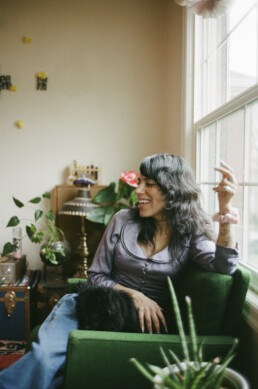
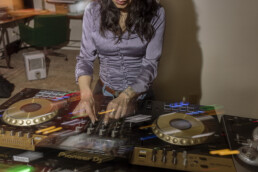
Inés Paulina Ramírez is a multidisciplinary artist who strives to create art in a language that reaches every individual who encounters her work from the universal understanding of humanity. Born and raised in Ecuador she was introduced to the world of art and musical expression through her upbringing alongside her family including her grandmother. With a degree in Fine Arts and Masters in Public Art she is involved with organizing within communities alongside activism and advocacy to create access to art. Along the way, she discovered her passion for spinning vinyl and digital and soon after, music became a foundational part of her artistic expression in addition to drawing, murals and painting, and occasionally working with paper materials.
“I feel like finding balance requires a lot of rationality.”
How would you describe what you do for a living?
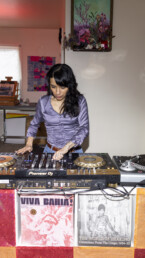
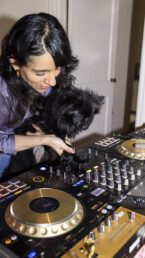
I do art. I’m an educator. I’m a multidisciplinary artist and a DJ. So I basically plan workshops, produce events, and DJ in different places.
Out of those mediums which are you most passionate about?
Well, I’m a multidisciplinary artist, so I come from drawing, painting, acrylics, video collage, [and] site specific [work]. Then I’ve been doing murals and printing. So I literally love to mix things and enjoy experimental media. So I don’t have a favorite one or one that I use the most. Now, for a living, I DJ a lot, introduce events and workshops, but things that I feel passionate about are more like personal projects, creativity projects where I can play and I don’t have to worry about something specific. I love to enjoy the process of discovery, discovering how far I can go.
"If I don't put attention to my creative side, it’s like i have someone crying in my soul."
How long have you been in Portland doing art?
12 years. I studied art in Ecuador, moved to Mexico for my masters and then I moved here.
What is your relationship to art and how did you know that’s what you wanted to do?
Since I was a little kid, coming from a family that loves music, [I] got stimulation around that. My dad and my grandma were always doing a lot of projects, like sewing and making bread. I was sculpting with dough and doing many things and starting to do my own shit. I think art just was there and I needed to play.
What inspires your art?
My father was a melomano and would blast music at 5 am to wake us up, i did my first sculptures with bread dough while baking with my grandma.
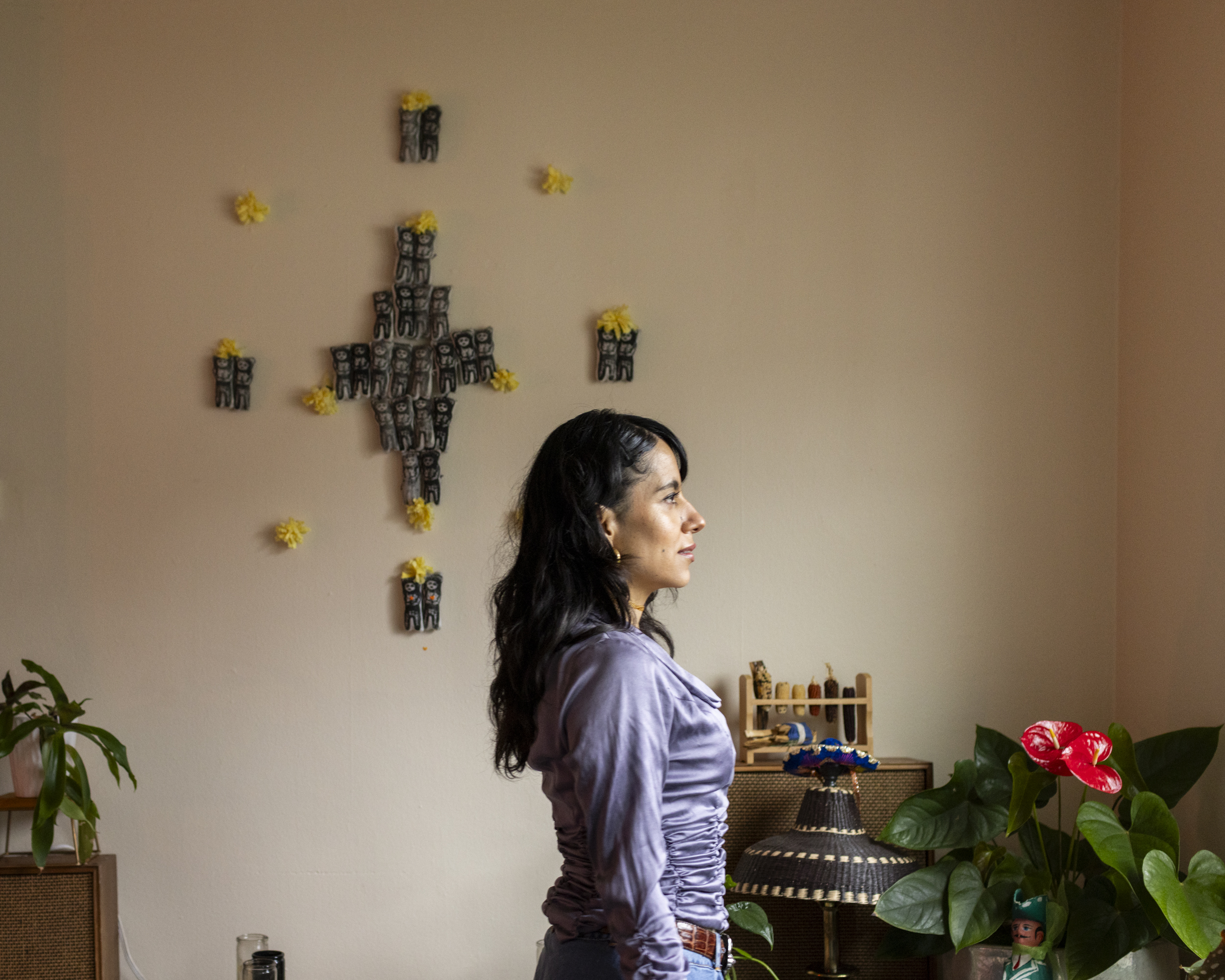
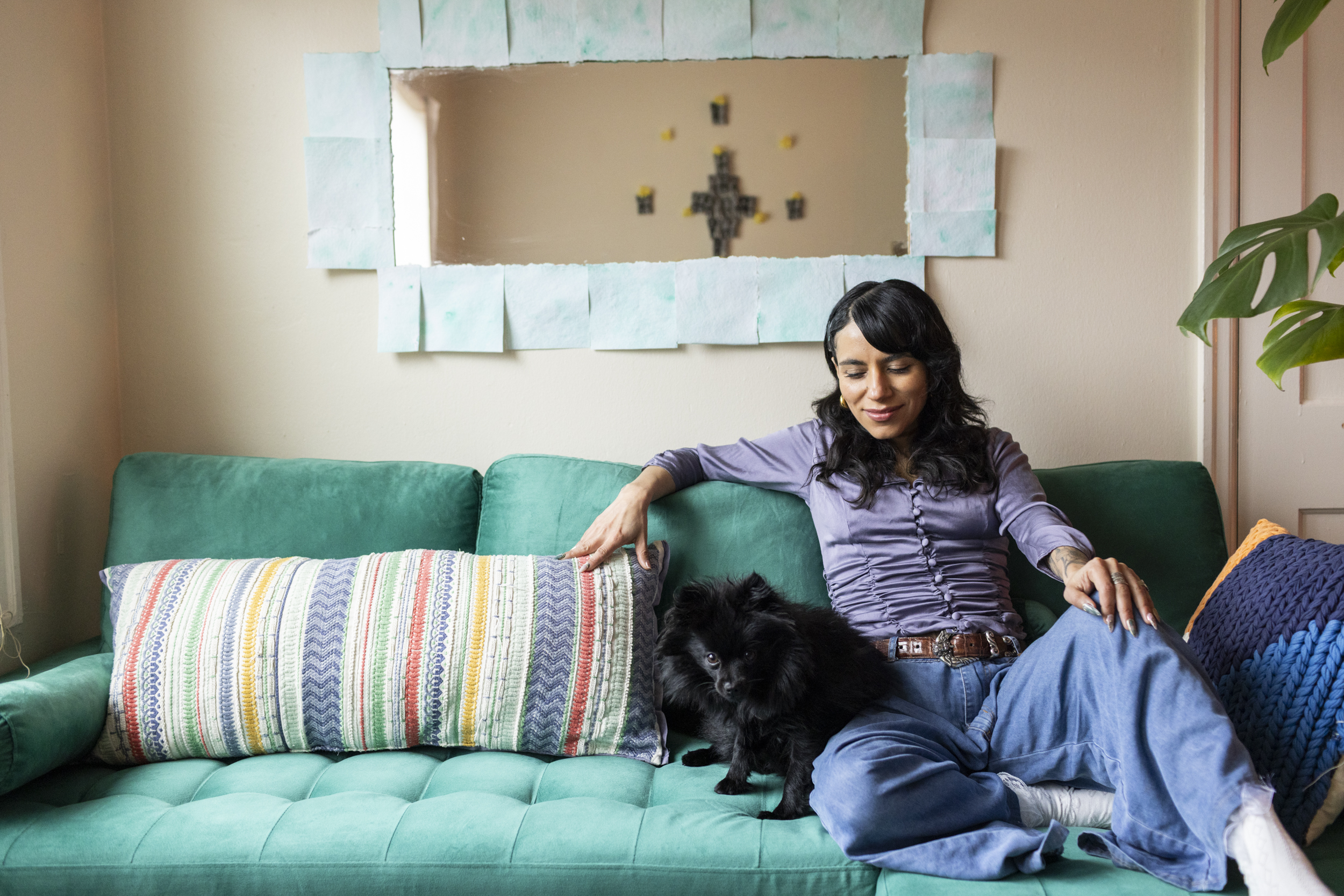
I think I get inspired by nature. Like landscapes, memories, and I love to look in archives. Textures [and] color really stimulate me. I’m a big fan of paper. I love to go out and look for paper– [it’s] one of my favorite things. I love having a blank space where I’m going to create a world. But you know people, their resilience, the fighting for freedom, and expression can be just to regulate peoples’ imaginations.
Walk us through your creative process.
Thinking in composition, contrast, balance, texture is the same as when we feel in sound to create , like collaging, cutting, pasting and mixing sounds, to see what happens. But, yeah, I’m always thinking in that [way] because music can stand for so many ways, but depending what I’m doing, automatically, when I’m choosing and selecting my sounds, I like to think in the region [and] in the landscape. I like to play a lot of music that connects with my land, with the mountains, with Ecuador, [it’s] what I like to like nerd around [with]. But also I love to bring music that brings joy, that connects with the world, like music from Africa, from the diaspora in Latin America, all that memory that connects the world. So I like to listen [to] all kinds [of music] as well. Like in a way, to give global sounds a big spectrum of sounds I really appreciate, global sounds because it can just be so different like the root[s] where it comes [from] brings the original sound as well. And it’s also a way to understand culture and politics from specific times through music appreciation.
How do you find work/life balance creating as a full-time artist?
Especially during this time, that’s been my struggle. I feel like finding balance requires a lot of rationality. Because, you know, we have a passion for that, and that’s all what we want to do, but we need to figure out ways that can be sustainable so we can still be able to do what we love, because the moment that we start to put all the energy in[to] work that we [don’t really] want to do, is when our creativity starts to question mark what are we doing and push us to find the balance, because if I don’t put attention to my creative side, it’s like i have someone crying in my soul.
For me, it’s making enough time to do the parts that are required in order to pay your bills and the other parts that have enough time that you can also dig deep in what you’re doing.
“I feel like Portland sometimes needs a filter to understand BIPOC voices”
What are some obstacles you encounter as a BIPOC artist?
I feel like Portland sometimes needs a filter to understand BIPOC voices and how things need to be in order to validate BIPOC art and that can feel a bit hostile and oppressive sometimes.
Also, the accessibility of the prices of rent [for] studio [space]– knowing that Portland has so much empty space and still, studios are very expensive, so it’s not sometimes an option to develop as big as you want to do. Depending [on] what you want to create, space really matters: how you organize your materials, how you plan and you want to do one sculpture, [if] you want to do something big scale. But that can sometimes be limited here– the accessibility for our studios [with] the prices are kind of crazy.
Was there ever a time where you almost stopped doing art? Why didn’t you?
I think it was many times, especially when I moved here to Portland, because I’ve been an art teacher since I studied visual arts at university in Ecuador, and when I moved to Mexico for my Masters, I worked organizing community projects of public art. And when I moved here, I didn’t have any connection[s] or actual experience about how this country works or its systems within art. I wasn’t ready for this wide[spread] capitalism since I came from community-based art systems. And I also felt language was a problem.
I thought, “How can I get into this?” You know? So eventually creating community and being curious around that, I got back involved with the world. I love to think and collaborate and do art with other people, because I can get exhausted when things are just about me or my personal feed. I love to have the balance of [creating] with others [which] feels fun. And, yeah, so at the beginning, it was hard. And I had to hustle doing whatever work I could for the first couple years. Then I had to start working as a teacher, doing side work, DJ’ing. I was super busy, and it was taking a lot of my creative energy. So it was for a little while that I stopped producing art. But then my body, my own soul, need[ed] to create.
What is the message that you try to communicate through your art?
I think I look to communicate in a language that can call to memory, to connect also with a universal language, with the cosmos, that provides space to imagine and feel the sensation of our bodies. So when something goes to that primary connection that we have as human[s] and can connect through our bodies, I like to think the relationship that we have with the geography, with landscapes, with the sounds, with spaces– that we can reimagine it, spaces where we can breathe, systems free of capitalism and patriarchy as well. Just like creating an autonomous system of imagination that is not conditioned to a capitalist system. So I want to be playful around it, but it’s always going to be a relation in my work with nature and with memory. So I just want to create a language that can touch people through that sensation.